.png)
India’s performance marketing landscape is entering a sharper phase in 2026.
For years, affiliate marketing in India was treated as a support channel — mostly driven by coupon sites, cashback platforms, and network-led publisher activity. But that view is changing.
As CAC rises across Google, Meta, marketplaces, and creator campaigns, brands are becoming more careful about where every rupee goes. The question is no longer just, “How much traffic can we buy?” The question is, “How much revenue can we generate with controlled risk?”
That is where affiliate marketing becomes important.
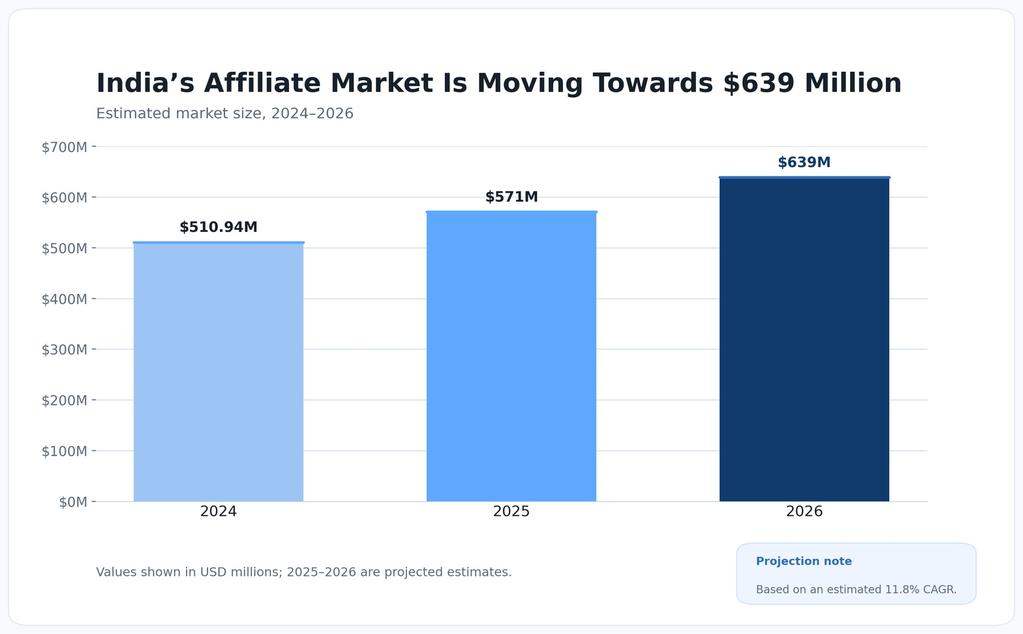
India’s affiliate marketing industry is projected to reach around $638–639 million in 2026, growing at an estimated 11.8% CAGR. Converted into Indian currency, that places the market roughly in the ₹5,300–₹5,500 crore range, depending on the exchange rate used.
This makes affiliate marketing one of the most important performance-led growth opportunities for Indian brands in 2026.
Why 2026 Matters for Affiliate Marketing in India
The growth of affiliate marketing is not happening because brands suddenly want more publishers. It is happening because the traditional paid media model is becoming harder to scale profitably.
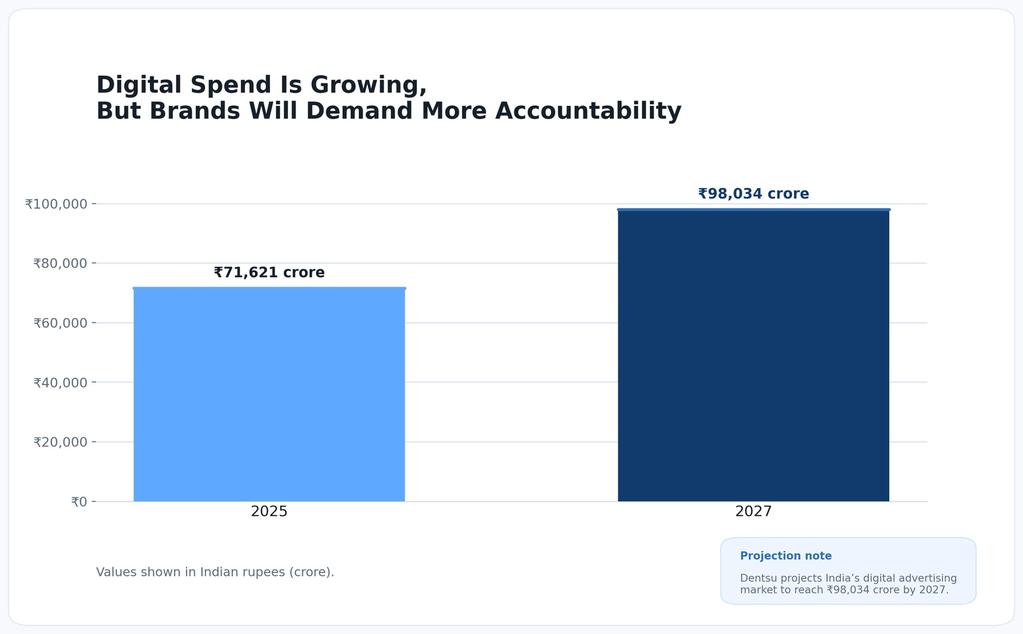
Digital advertising in India is still growing strongly. Dentsu’s Digital Advertising Report 2026 states that India’s digital advertising market reached ₹71,621 crore in 2025 and is projected to reach ₹98,034 crore by 2027.
That means brands will continue spending heavily on digital. But the pressure to connect spend with actual business outcomes will become much stronger.
Affiliate marketing fits directly into this shift because brands pay for measurable actions — sales, leads, bookings, app installs, or validated conversions — instead of paying only for impressions or clicks.
The Shift: From Ad Spend to Outcome Spend
The biggest change in 2026 will be budget behaviour.
Brands will not stop spending on Google, Meta, influencers, marketplaces, or programmatic advertising. But they will become more selective. Channels that require heavy upfront spending without guaranteed results will face more scrutiny.
Affiliate marketing gives brands a more controlled model.
Instead of paying first and hoping for results, brands can structure payouts around validated performance. This is especially useful for categories like:
- Fashion and lifestyle
- Beauty and personal care
- Travel and hospitality
- Health and wellness
- Consumer electronics
- Fintech
- Edtech
- Home and decor
- Jewellery
- D2C brands
For these categories, affiliate marketing can work as a parallel acquisition engine — combining publishers, creators, content platforms, deal communities, comparison sites, cashback partners, and loyalty platforms.
The result is not just more traffic. It is diversified customer acquisition.
Creators Will Push Affiliate Growth Further
Another important reason affiliate spends will grow in India is the formalisation of the creator economy.
India’s influencer marketing industry is projected to reach ₹5,000 crore by 2027, according to a recent Kofluence report cited by The Economic Times. The report points to creator formalisation, stronger accountability, AI-led efficiencies, and tighter regulation as key drivers.
This matters because creators are no longer only branding partners.
In 2026, more creators will become performance partners through:
- Affiliate links
- Tracked coupon codes
- Revenue-share campaigns
- Creator-led storefronts
- Hybrid fixed + performance models
- Long-term ambassador programs
For Indian brands, this is a major opportunity. Consumers in India often respond strongly to trust-led recommendations, regional content, and niche creators. A YouTube reviewer, Instagram creator, finance community, parenting blogger, or fashion content page can influence purchase decisions in a way that standard paid ads cannot always replicate.
The Problem: Most Affiliate Programs Are Still Under-Managed
The opportunity is large, but many Indian brands will still struggle to scale affiliate marketing.
Why?
Because launching an affiliate program is not the same as managing one.
A weak affiliate program usually depends too much on coupon partners, has limited publisher diversity, poor validation hygiene, delayed partner communication, and little to no fraud control.
A strong affiliate program needs active management across:
- Publisher recruitment
- Creator onboarding
- Commission planning
- Tracking accuracy
- Fraud checks
- Validation rules
- Partner communication
- Monthly optimisation
- Content-led partnerships
- Performance reporting
This is where many brands go wrong. They treat affiliate marketing as a plug-and-play network listing instead of a managed growth channel.
In 2026, that approach will not be enough.
What Indian Brands Should Do in 2026
Affiliate marketing should not be treated as a discount channel. It should be treated as a structured partner ecosystem.
For a fashion brand, that could mean working with style publishers, creators, cashback platforms, wedding blogs, student communities, and shopping recommendation pages.
For a travel brand, it could mean activating travel bloggers, itinerary platforms, credit card communities, deal publishers, YouTube creators, and regional travel pages.
For a beauty brand, it could mean building partnerships with skincare reviewers, ingredient-led blogs, influencers, coupon platforms, and content publishers.
The brands that win will be the ones that build a balanced publisher mix — not the ones that depend only on last-click coupon traffic.
Final Takeaway
India’s affiliate marketing industry is projected to reach around $638–639 million in 2026, or approximately ₹5,300–₹5,500 crore.
But the more important shift is strategic.
Indian brands are moving from traffic-first marketing to outcome-first marketing. Rising CAC, growing digital spends, and the formalisation of creators are pushing brands to look for acquisition channels where spend is tied directly to performance.
Affiliate marketing fits that need.
In 2026, the strongest brands will not simply run affiliate programs. They will build managed partner ecosystems — combining publishers, creators, content platforms, loyalty partners, and performance tracking into one measurable revenue channel.
Affiliate marketing in India is no longer just a support channel.
It is becoming a serious growth channel.


.png)