
.png)
Affiliate marketing is becoming a serious performance channel for Indian brands.
India’s affiliate marketing industry is projected to reach around $639 million in 2026, growing at an estimated 11.8% CAGR. At the same time, India’s digital advertising market continues to expand, with digital ad spends reaching ₹71,621 crore in 2025 and projected to touch ₹98,034 crore by 2027.
This growth is forcing brands to think differently about customer acquisition.
Google and Meta are still important. Marketplaces still matter. Influencer campaigns still drive visibility. But rising CAC has made one thing very clear: brands now want channels where spend is linked more directly to outcomes.
That is why affiliate marketing is gaining attention.
But once a brand decides to take affiliate marketing seriously, the next question usually appears:
Should we manage affiliate marketing in-house?
At first, the answer looks obvious. Building an internal team seems more controlled, more transparent, and possibly cheaper than working with an agency or network.
But affiliate marketing is rarely that simple.
Why Brands Consider In-House Affiliate Marketing
There are valid reasons why brands want to manage affiliate marketing internally.
In-house teams give the brand more control over publisher approvals, commission rules, campaign messaging, and monthly priorities. Internal teams also understand the brand better than any external partner can. They know product margins, seasonal priorities, inventory pressure, customer segments, and category-level profitability.
For large brands, this can be powerful.
An internal affiliate team can work closely with performance marketing, CRM, influencer marketing, category, finance, and tech teams. This makes decision-making faster and keeps strategy closer to the business.
So yes, in-house affiliate marketing can work.
But only when the brand treats it as a complete growth function — not as an extra task assigned to one performance marketer.
What Brands Usually Underestimate
Affiliate marketing is often misunderstood as a simple setup:
- Create tracking links.
- List the program.
- Approve publishers.
- Pay commission on sales.
That is the surface-level version.
The real work is much deeper.
A serious affiliate program needs continuous publisher recruitment, creator onboarding, commission planning, fraud checks, validation hygiene, tracking accuracy, coupon monitoring, payout coordination, reporting, and monthly optimisation.
It also needs strong partner communication.
Publishers need updates. Creators need briefs. Cashback partners need campaign clarity. Content platforms need category-level hooks. Coupon partners need rules. Finance teams need clean validation cycles. Tech teams need accurate tracking.
If all of this is not managed properly, the program usually becomes coupon-heavy, under-optimised, and difficult to scale.
That is when brands start saying, “Affiliate marketing does not work.”
In reality, the channel may not be the problem.
The management structure is.
The Real Cost of Building In-House
The biggest myth about in-house affiliate marketing is that it automatically saves cost.
It may save agency fees, but it creates internal costs that brands often do not calculate properly.
A brand may need:
| Requirement | What It Really Means |
|---|---|
| Affiliate Manager | Owns strategy, publisher relationships, reporting, and growth. |
| Publisher Outreach | Finds and negotiates with content sites, coupon partners, creators, loyalty platforms, and communities. |
| Tracking Platform | Manages attribution, conversion data, fraud checks, and reporting. |
| Finance Support | Handles validation, invoices, publisher payments, and payout cycles. |
| Tech Support | Ensures tracking, postbacks, pixels, and attribution logic work correctly. |
| Compliance Monitoring | Checks coupon misuse, brand bidding, fake orders, and policy violations. |
| Creator Partnerships | Activates influencers on performance or hybrid models. |
| Reporting & Optimisation | Reviews publisher mix, commissions, conversion quality, and monthly growth opportunities. |
This is not a one-person job if the brand wants scale.
It needs process, tools, and partner relationships.
And that is where the hidden cost appears.
In-House Works Best When the Brand Has Scale
In-house affiliate marketing makes the most sense when a brand already has enough volume to justify a dedicated team.
For example, if a brand is already generating strong affiliate revenue every month, has internal tech support, understands performance marketing deeply, and has the budget to hire experienced affiliate talent, then in-house management can be a strong model.
It also works better when the brand has:
- High monthly traffic
- Strong product-market fit
- Healthy margins
- Clear commission flexibility
- Internal performance marketing maturity
- Fast finance and validation support
- Access to publisher relationships
- A strong creator or content ecosystem
Without these, the in-house model can become slow and operationally heavy.
The brand may save on external fees but lose speed, partner access, and execution quality.
When In-House Becomes a Problem
In-house affiliate marketing usually struggles when it is treated as a side responsibility.
For example, a performance marketer already managing Google, Meta, marketplaces, email, and analytics may also be asked to “handle affiliates.”
That rarely works.
Affiliate marketing needs daily relationship management. Publishers do not activate themselves. Creators do not automatically push campaigns. Coupon misuse does not fix itself. Fraud does not disappear without monitoring. Validation delays can quickly damage partner trust.
The channel becomes weak when there is no one actively managing:
- Who should be recruited
- Who should be removed
- Which partners are driving incremental sales
- Which partners are only capturing existing demand
- Which coupons are being misused
- Which creators are worth scaling
- Which publisher categories are missing
- Which campaigns should run next month
Without this discipline, affiliate marketing becomes reactive instead of strategic.
The Creator Layer Makes It More Complex
Affiliate marketing in 2026 will not only be about traditional publishers.
Creators are becoming a major part of the performance ecosystem.
India’s influencer marketing industry is projected to reach ₹5,000 crore by 2027, as the creator economy becomes more formal and performance-focused.
This matters because brands are increasingly trying to convert creators into performance partners through affiliate links, tracked codes, revenue-share models, hybrid campaigns, and long-term ambassador programs.
But managing creators under an affiliate structure is different from running a normal influencer campaign.
You need clear tracking, payout rules, content guidelines, performance benchmarks, campaign communication, and fraud-safe attribution.
For many brands, this becomes difficult to manage internally unless they already have a strong creator partnerships team.
Agency-Led Affiliate Management: Where It Helps
An agency-led model makes sense when the brand wants faster execution without building the entire function from scratch.
A specialised affiliate agency can support with:
- Publisher recruitment
- Creator activation
- Network or tracking platform management
- Commission strategy
- Fraud and compliance checks
- Validation coordination
- Monthly optimisation
- Campaign planning
- Partner communication
- Reporting and growth reviews
The advantage is not just manpower.
It is access.
A strong affiliate agency already knows which publishers, creators, coupon platforms, content sites, loyalty partners, and communities are relevant for different categories.
That learning curve is expensive to build internally.
For brands that want to test affiliate marketing seriously without hiring a full internal team, an agency-led model is often more practical.
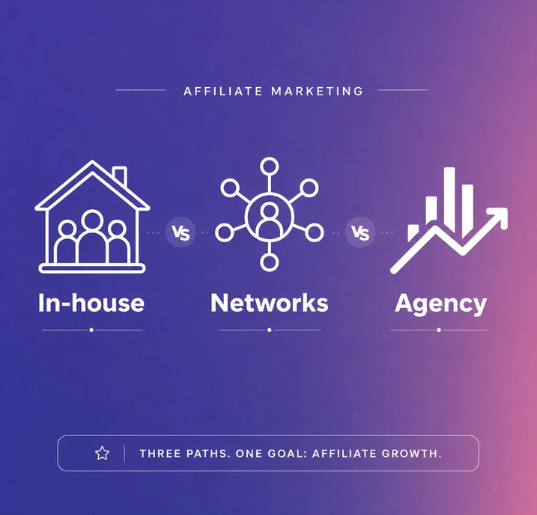
So, Should Indian Brands Run Affiliate Marketing In-House?
The answer depends on maturity.
If the brand has strong affiliate revenue, internal expertise, publisher access, tech support, and the ability to manage partner operations daily, then in-house can work well.
But if the brand is still exploring affiliate marketing, has limited internal bandwidth, or wants to scale faster through publishers and creators, then an agency-led or hybrid model is usually more efficient.
In-house is not wrong.
But underestimating affiliate marketing is.
The channel needs active management, clean tracking, strong validation, publisher relationships, creator activation, and constant optimisation.
Without that, the brand may technically have an affiliate program — but not a scalable affiliate channel.
Final Takeaway
Affiliate marketing in India is becoming bigger, more competitive, and more performance-led. As the market grows, more brands will consider managing it internally.
That is a good sign.
It means affiliate marketing is no longer being treated as a small side channel.
But brands need to be realistic.
An in-house affiliate program can work, but only when the brand is ready to invest in people, tools, processes, publisher relationships, compliance, and execution.
For most growing Indian brands, the smarter starting point may be a hybrid model — where strategy stays close to the brand, while execution is handled by specialists who already understand the affiliate ecosystem.
In 2026, the question is not just whether a brand should run affiliate marketing in-house.
The better question is:
Does the brand have the structure to manage affiliate marketing properly?


.png)