
.png)
Launching an affiliate program can give an ecommerce brand another route to customers without depending entirely on paid media. But an affiliate program does not become successful simply because commissions are paid after a sale. The model still needs viable economics, reliable tracking, relevant partners, clear rules and someone actively managing the channel.
For Indian D2C and ecommerce brands, the best time to start is not necessarily when traffic reaches a certain level or when competitors launch their own programs. It is when the business can answer a more practical question: can we reward partners competitively, validate transactions accurately and give them enough reason to promote us consistently?
A strong affiliate program starts with those foundations before the first publisher is recruited.
Check Commercial Readiness
Before choosing a network or speaking to publishers, understand what the business can afford to pay for an affiliate-generated customer.
That calculation should begin with margin, not revenue. Product costs, shipping subsidies, payment charges, discounts, returns and other variable costs affect how much room exists for commission. Average order value and repeat purchase behaviour can provide additional context, but future customer value should not be used to justify payouts the business cannot realistically sustain.
There is no universal commission percentage that every affiliate program should offer. Current affiliate-platform guidance similarly recommends balancing partner attractiveness with margins and long-term affordability rather than copying a standard rate from another advertiser.
Indian ecommerce brands should also think about the validation period before launch. If orders can be cancelled, returned or fail during fulfilment, commission should not necessarily become final as soon as the transaction is tracked. The validation process needs to reflect the brand's real order lifecycle.
Choose the Operating Model
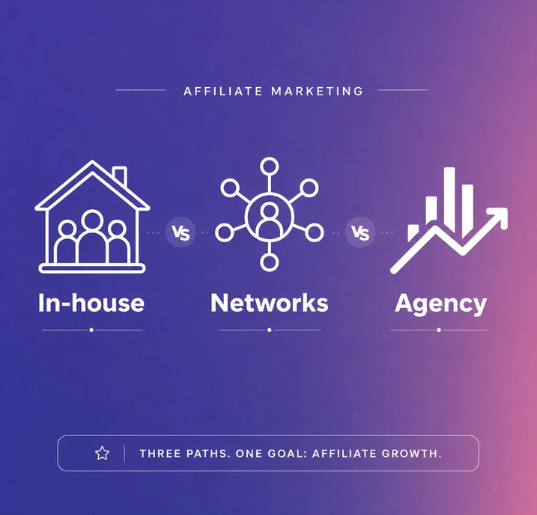
An affiliate program can be managed in-house, through a network or partnership platform, with an affiliate marketing agency, or through a hybrid structure.
The important distinction is between technology and active management.
A network or tracking platform can provide infrastructure for tracking, reporting, commission rules, partner discovery and payment workflows. Program management covers the work required to turn that infrastructure into a functioning growth channel, including recruitment, partner communication, activation, commission planning, compliance, validation and optimisation.
A brand with an experienced internal affiliate manager may be able to manage the channel directly through a platform. Another business may prefer specialist external management while retaining strategic and commercial control internally. The correct structure depends on capability and bandwidth, not on whether one model is universally better.
Build Tracking Before Recruitment
Publishers should not be invited into the program until transactions can be tracked reliably.
The setup needs to identify which partner generated an eligible transaction, preserve the information required for commission calculations and support the validation process. Depending on the technology stack, this may involve first-party, server-to-server, hybrid or other tracking methods. Current affiliate platforms have increasingly moved toward server-side and first-party approaches as browser restrictions make older tracking methods less dependable.
Brands should also define their attribution rules before launch. Decide how long a referral remains eligible for credit, what happens when multiple affiliate partners appear in the journey, how promotional codes are treated and whether specific creator codes or other identifiers can influence attribution.
The aim is not to create the most complicated attribution system possible. It is to make the rules clear enough that both the advertiser and its partners understand how transactions will be credited.
Design Commissions With Intent
The simplest affiliate programs may begin with one standard commission structure, but different partner types can create different forms of value.
A content publisher investing time in a detailed review may need different economics from a coupon partner. A new customer may be worth more to the brand than a repeat purchase. Products with stronger contribution margins may support a different payout from lower-margin categories.
Affiliate platforms increasingly support these kinds of segmented commission structures, including rates based on publisher, customer type, product category and other transaction data.
Commission design should therefore answer two questions at once: what can the brand afford, and what behaviour does it want to encourage?
Define the Program Rules
Affiliate terms and conditions should be ready before publishers begin promoting the brand.
The program should explain how affiliates may use the brand name, whether paid-search or trademark bidding is permitted, which promotional codes may be published, how sub-affiliate activity is handled and what promotional practices are prohibited.
Coupon policy deserves particular attention. Brands should decide whether affiliates can list codes sourced from elsewhere, how exclusive codes are treated and what happens when a customer uses a creator or publisher-specific code without clicking an affiliate link.
If creators participate through affiliate or hybrid compensation, disclosure requirements also remain relevant. ASCI's influencer advertising guidelines require disclosure where a material connection exists between an advertiser and influencer, including relationships involving compensation or other value.
Build a Balanced Partner Mix
An affiliate program should not be treated as a synonym for coupon marketing.
Content publishers can introduce products and explain categories. Comparison and review partners can help customers evaluate alternatives. Cashback and loyalty platforms can reach established member bases, while coupon publishers can support customers who are actively looking for an offer.
Communities, closed-user groups and strategic partners can create access to more specific audiences. Creators can participate through affiliate or hybrid structures when performance-linked compensation fits the relationship. Other partnerships may emerge from businesses serving complementary customers rather than traditional affiliate publishers.
Current network guidance similarly recommends building a diverse partner mix rather than depending on one publisher category.
The correct mix should reflect how customers discover, research and purchase the brand's products.
Validate and Protect the Program
Tracked sales should pass through a consistent validation process before commissions become final.
Cancelled orders, refunds, returns, duplicate transactions, fraudulent activity and other ineligible sales should be handled according to clear rules. Some affiliate platforms support automated validation workflows that adjust or decline transactions as order status changes.
Compliance monitoring should continue after publishers are approved. Brands need visibility into how partners are using trademarks, promotional codes, advertising claims and traffic sources. The purpose is not to make the program restrictive. It is to protect the economics of the channel and ensure legitimate publishers are not competing against behaviour that violates the program rules.
Measure Partner Quality
Affiliate reporting should move beyond total attributed revenue.
Brands should understand which publishers are active, which generate valid transactions, which contribute new customers where that can be measured, and whether the program has become excessively concentrated around a small number of partners.
Customer journey analysis can add another layer. A publisher receiving last-click credit may not be the only partner that influenced the purchase, while a content partner that appears earlier in the journey may contribute value that is not obvious from final-click revenue alone.
Attribution should not be confused with incrementality. Some affiliate platforms now provide reporting specifically designed to examine partner contribution across the purchase journey rather than relying exclusively on final-click sales.
These signals help brands decide which partnerships deserve more investment rather than simply rewarding the largest revenue number in the dashboard.
Move From Launch to Scale
Before launch, the brand should have its tracking, attribution rules, commercial limits, commission structure, validation period, publisher terms, coupon policy, promotional assets and internal ownership clearly defined.
The first stage should focus on getting those foundations working with a manageable set of relevant publishers. As the program develops, the emphasis can move toward recruiting new partner types, reactivating dormant publishers, negotiating stronger placements, segmenting commissions and improving how partner quality is measured.
Scaling an affiliate program should not mean approving more affiliates as quickly as possible. It means building more productive partnerships without losing control of margins, tracking or brand standards.
For Indian D2C and ecommerce brands, that is the difference between launching an affiliate program and building an affiliate revenue channel. Creative Cuddle's Affiliate & Partnerships work helps brands design and manage that operating system, from the commercial foundations and tracking through to publisher development and ongoing optimisation.




.png)